Mapping Maps #7
Apr 30, 2019

I think one of the challenges and on at least one of the occasions when I’ve used maps... a pitfall that we fell into is one can get quite focused on componentisation, like components and processes and forget about people. And people are such a core part of anything that you do... when you’re doing a map, be careful not to forget about the people bit.
— A participant, Building Situational Awareness paper
Welcome to April edition of Mapping Maps! Here’s sharing with you this month’s best of curated stuff on mapping.
MAP CAMP ATL
Big event of the month, of course, was the Map Camp ATL with an impressive lineup of talks. Check this write-up on the event for key highlights and some great takeaways shared by Tristan Slominski.
Process vs Evolutionary Flow
Specifically in Simon's talk, the big point seemed to be process vs evolutionary flow. I believe this point goes hand in hand with last month's discussion on role of Y-axis with Simon stating - "The only real axis is the x-axis". When focusing primarily on the process flow across Y-axis, the big risk we may run into is making the "highly ineffective more efficient" (H/T Claire Moss!)Stephen Kuenzli shared his acute observations on this matter as a problem of an organization ‘trapped’ in an existing context -
"This inertia encourages organizations to optimize an existing process when the organization could be better off evolving that process to a better fundamental configuration."
Stephen ends his piece offering this pragmatic advice -
"You don’t have to keep doing things the same way. Use mapping, retrospectives, and other learning techniques to discover the major evolutions that are possible in your technology landscape. If you limit your organization to incremental improvements, you’ll miss out on the really good stuff."
Agreed - on most occasions, it's far more valuable to focus on the evolutionary flow. However, in my humble opinion, once you get the evolutive placement of the components (almost) right, there is value to gain through Lean style process improvement of a value chain. Especially in the Product / Commodity areas of a map and I guess this is what the Settlers / Town Planners specialize in. As Taiichi Ohno, the founding father of Toyota Production System, said making the case for flow efficiency -
"All we are doing is looking at the time line, from the moment the customer gives us an order to the point when we collect the cash. And we are reducing the time line by reducing the non-value adding wastes."
A grandma, a blind guy, and a millenni-lady walk into a bar... and start sketching maps on the back of napkins.
— Cat Swetel
MAPS OF THE MONTH
Here's a collection of some interesting maps shared in the community this month -Mapping Right Timing
I cannot emphasize enough the importance of this. It is only through other forms of maps that the field will grow
— Simon Wardley
MAPS TALK
Here's a round up of a few write ups on mapping shared this month -Building Situational Awareness with Maps
There's now a finalized version of the paper on significance of situational awareness in navigating constantly shifting digital landscape. The remarkable paper goes on to describe how Wardley Mapping enables situational awareness in the midst of ever changing components of a digital system.My favorite part was characterization of maps as "performative" i.e. maps being both acting and constituting reality -
"Just as Garud et al. (2014) show narratives as performative, where “to say something is to do something” ((Austin, 1975, p. 12; italics in original) – for a review of the term see (Gond et al., 2016)) so maps themselves perform. Like other narrative devices, our findings show maps not as purely mapping the “outside the world(s) to which they refer”, but also that they are “actively engaged in the constitution of the reality that they describe” (Callon, 2007, p. 318). Like other narrative devices, maps “and their world are caught in a process of co-evolution” (Callon, 2007, p.329). We observed in our findings the production of maps to be sometimes an act of rebellion through which strategic change was achieved. In one instance, the past digital ecosystem of an organisation was rendered clearly unsustainable in a ‘fur-ball’ of nodes and vertices on a demonstratively complex map. This could then be used to justify significant change in infrastructure within a number of organisations."
Game Play Series
Chris Daniel shared some insightful details on Game Play with some great real world examples -- Customer Isolation
- Basic Constraints
- Embrace&Extend
- Threat Acquisition
- Signal Distortion
- Vertical Movements
- Fighting with “Open”
- Influencing your Customers
"Game play - the most seductive part of mapping that comes at last. In the beginning it is all about fixing your operations (adopting Doctrine), nothing fun, just hard work. Later, it is about weighting risks and profits, and manipulating the Landscape (f.e. removing the barriers to entry to your opponent business, raiding talents or building alliances or any other usage of Context-specifc Patterns translated into your environment). In short, it is what you do to maximise overall well-being of your company. "
Mapping Fear of Missing Out
Kaimar Karu with pointers for tech leaders on how to do the right thing in between the two extremes of inertia vs fear of missing on new technology -"Pay attention! Rather than panicking or getting over-excited every time you hear about something new, pay attention to what’s happening on the market. Keep your eyes and ears open to weak signals. Use mapping."
Wardley mapping and IT strategy
Mike Haber shared these beautiful slides. With some wonderfully done visuals, they look great for introducing anyone to Wardley Mapping.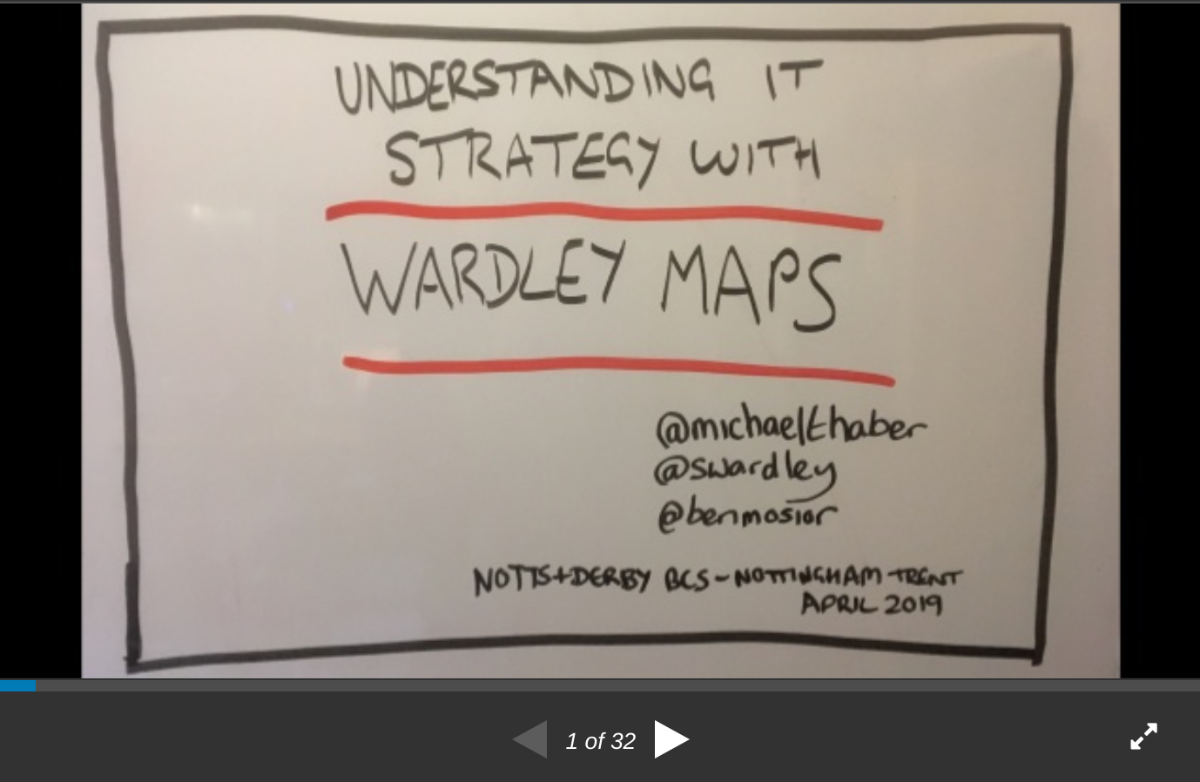
Wardley Maps on ThoughtWorks Tech Radar
A shoutout to Wardley Mapping, which I learned about for the first time in Atlanta this week, and is now influencing how I approach consulting and advising.
— Liz Fong-Jones at Devopsdays Atlanta