Mapping Maps #4
Jan 31, 2019

The best moments are when people use my own maps to tell me I'm wrong on something. That's how it should be. The worst moments are when people ask me to map for them, they're missing the point.
— Simon Wardley
Welcome to this January edition of the Mapping Maps newsletter. The month when there was far more valuable stuff to learn from Simon Wardley's tweetstorms than one can expect from loads of books on those subjects. Here's a great curated list of his recent Twitter responses on questions around mapping.
We begin this month's newsletter with a two of such recent Twitter threads. Followed by a roundup of what's happening in community around mapping.
Hacking Organizational Design
A big learning of the month was on organizational design via these twitter threads -Though the topic has been previously covered here in detail, what makes the threads really interesting is getting to know the backstory behind origin and development of the PST model. It's amazing to see such experimentation at org structure level and the courage to make the changes based on the feedback (which usually was that the teams weren't getting along).If you like to see a model from multiple perspectives, here are some recommended sources on PST and similar ideas -
GCHQ's Boiling Frogs research paper
3X model by KentBeck - more details here and here
The Three Machines
The Power of the Elastic Product Team
Exploring Pioneers, Settlers and Town Planners
Sustainable Innovation - 3 Types of Work (pdf)
Cloud adoption requires a TriModal organization
Following talk on Surviving the Framework Hype Cycle by Brandon Hays as detailed in this thread -
Busting Business
Another favorite this month was the tweetstorm on Capital Flowand how, with mapping, the components of business get disrupted one by one -
Busting Finance
"Finance lacks context, so can't effectively measure capital flow, stocks and potential future. Everything built on that is a house of cards."
Busting Project Management
"This tendency to one size fits all methods, again because of a lack of context, results in continuous failure and endless arguments."
Busting HR
"This belief in a single size fits all culture, the inability to recognise not only aptitude (skill) but attitude (cultural style), to plan a path forward on how things change."
Busting Strategy
"The inability to distinguish between climatic patterns and context specific play, the inability to see the obvious changes, the memes, the endless memes."
Busting Business
"The inability to communicate across multiple groups, to bring these components into a cohesive whole, to understand the context."
Maps of the Month
Here's a collection of this month's interesting maps shared by community on Twitter -Mapping Cyber Attacks
A map shared by by Tony Richards as an example of mapping security -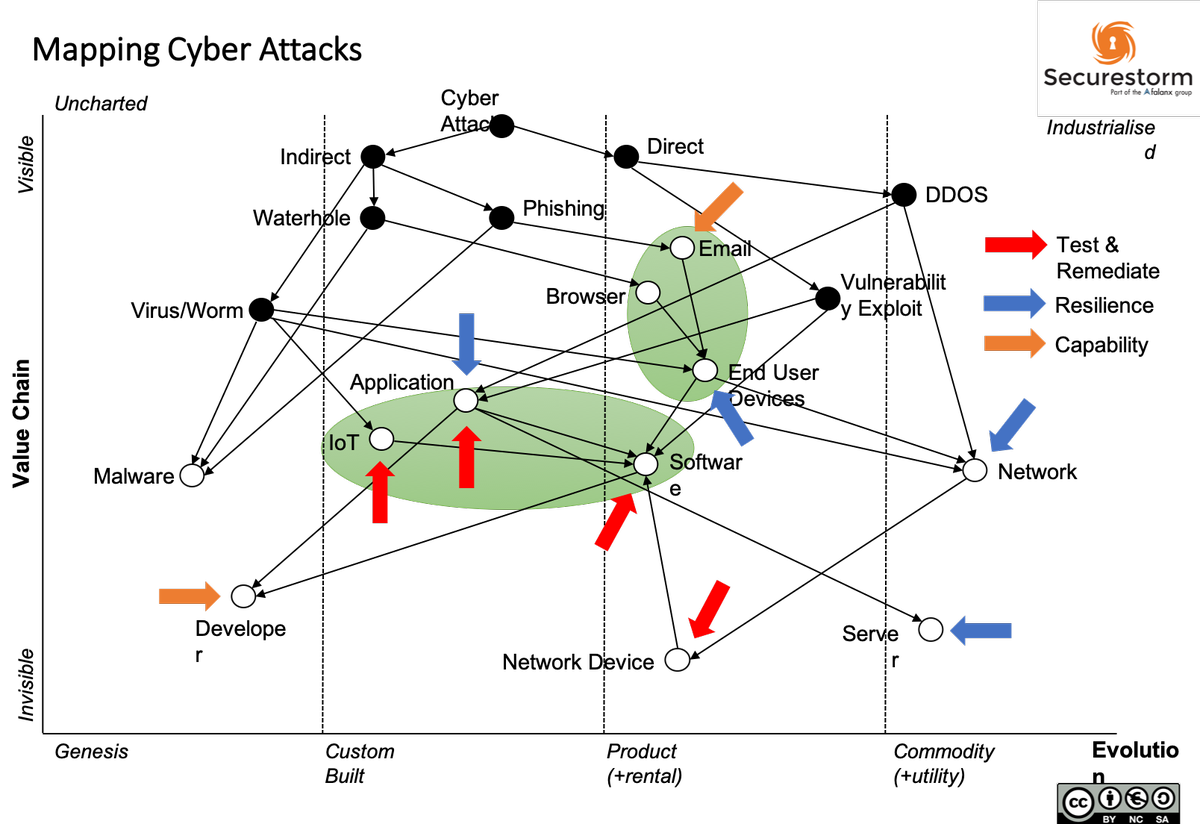
Building computers in the basement
This map by Ian Waring may look funny and exaggerated at first but considering how often we fail to see components that are actually commodities, the map seems to be a more closer depiction of reality (thanks to Mike Carlisle for sharing this) -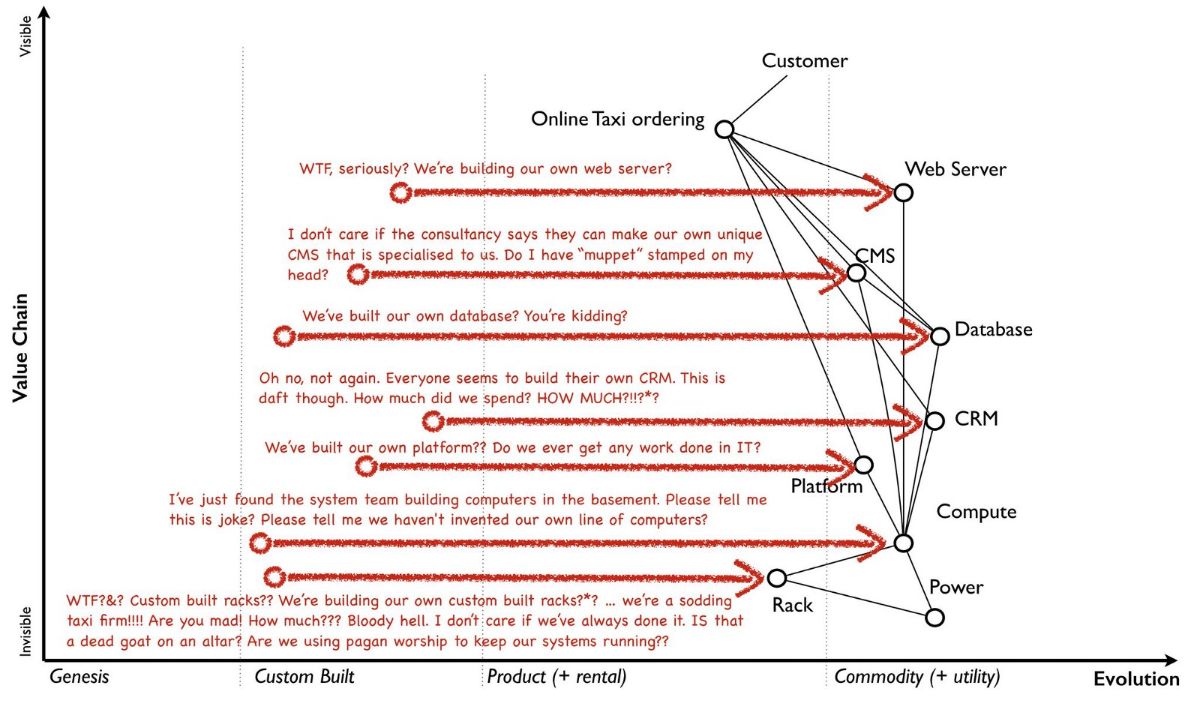
PST 3X Fusion
A map by Manuel Küblböck demonstrating an ideal team composition by overlaying PST model on Kent Beck's 3X (Explore, Expand, Extract) as shared here -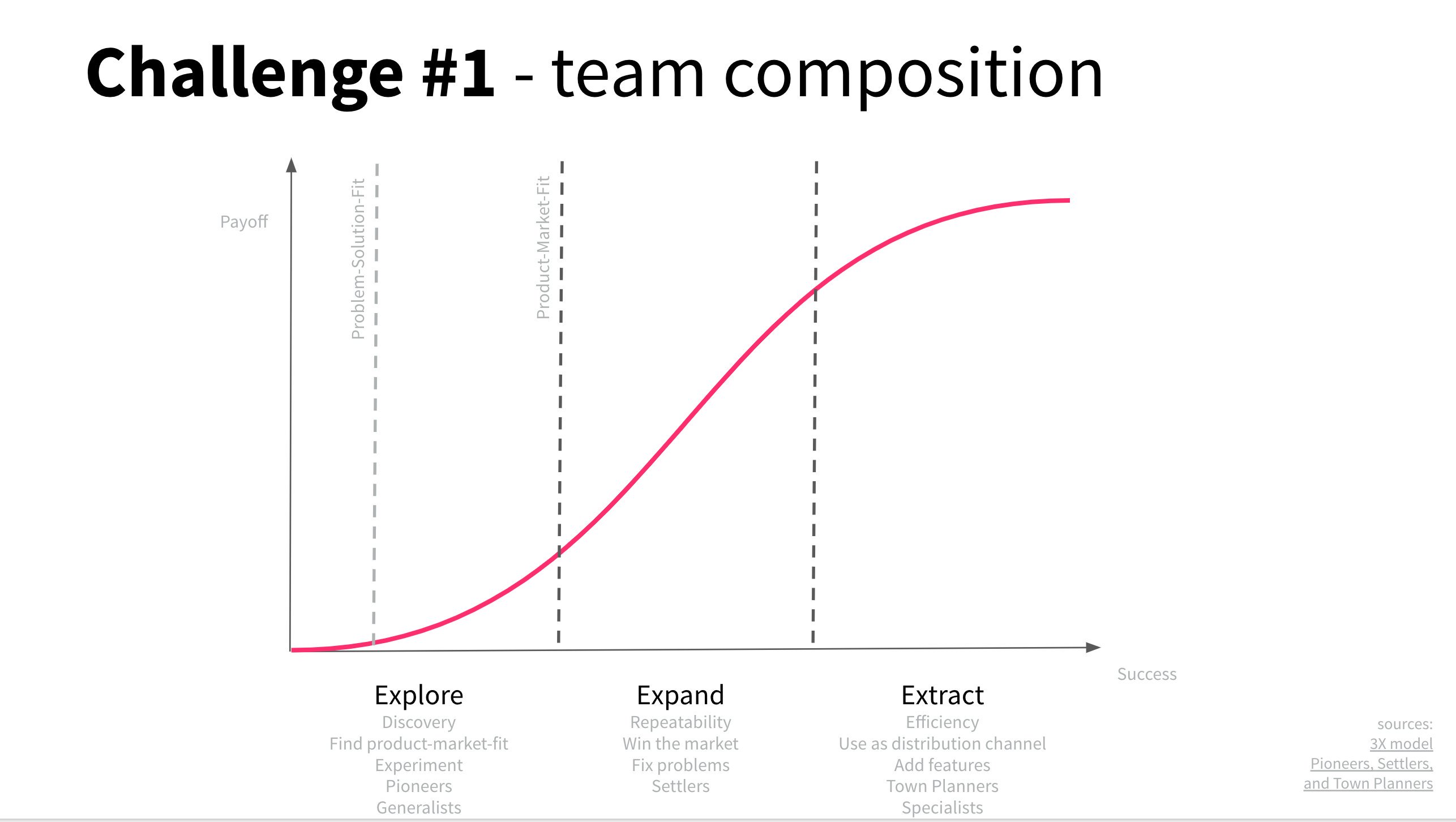
Maps Talk
Be wary of the Wardley Kool-Aid! Once you quaff deeply, you'll soon start wandering around the office muttering "grrr, needless duplication of a commodity" and "bah, humbug, they can't see the intertia in their own thinking".
— Ian Walker
Wardley Maps — an Illustration from Gerstner’s book
To more vividly illustrate Wardley Mapping, Julius Gamanyi takes this fascinating approach of mapping chapters of Lou Gerstner’s book -Who Says Elephants can’t Dance. Julius attempts to visualize narratives and strategic thinking of Gerstner by retrospectively portraying them unto Wardley Maps.He begins by drawing a map with simplified view of IBM in the mid-1990s and how it evolves based on Gerstner’s decisions and strategy cycle. It's a great read and education into both applied Wardley Mapping and story of Gerstner’s historic turnaround of IBM.
"Regarding learning to map, the task is two-fold: to find materials ample enough to cover all the elements of Strategy (in business), and on the other hand, to express them on one or several Wardley Maps. Relevant books and articles furnish us with materials. What’s left, for us learners, is to map them."
Mapping Power
In this series, Tasshin Fogleman argues for complementing mapping with elements of power dynamics of an organization -"All projects that involve multiple humans will succeed or fail on the basis of power. Skill in power is always needed, in any leadership position (including unofficial leadership positions). Without being savvy at perceiving and affecting power dynamics, you are sure to fail."
Burja Mapping, the solution he offers, is a combination of Wardley Maps and Empire Theory -
"Mission statements, goal setting processes, and other frameworks help you answer the question “Why?” Financial statements and realities constrain what is possible, answering the question “How much?” Although less commonly used, Wardley Mapping and the more recent Maturity Mapping help you answer the question “What?” and “How?” By contrast, Burja Mapping lets you answer the question “Who?”"
Art of Strategy
In this concise introduction to strategy, Erik Schön curates from multiple sources like Sun Tzu’s Art of War and writings of John Boyd and Simon Wardley. It really is a nice read."I hope it can act as a gateway that will inspire you to go to the sources — The Art of War, A Discourse on Winning and Losing and Wardley Maps — in order to learn more and start strategizing using maps."
The Real Future of the Platform Economy
In this excellent write-up, Simone Cicero predicts on where the markets are heading from platforms / ecosystems perspective. Check this video for Simon Wardley's discussion with the author on the topic of Understanding Platforms through Wardley Maps (as was shared in November edition of the newsletter)."I used Wardley Maps, to plot our unified market theory against evolutionary value chains, and I’ve been able to explain how aggregators are applying a series of key basic “strategic gameplays” to transform linear industrial value chains into post-industrial systems of value chains and networks."
He further shares his thoughts on how the platforms/aggregators/marketplaces are set to play an increasingly important role in the economy -
"Aggregators replace mass-produced, one-size-fits-all manufactured solutions in favor of systems that able to produce a long tail of tailored niche experiences. Aggregators do this by bringing producers back on the top of the value chain, treating them as key participants to the value creation process, connecting them with their peer consumers to provide contextualized solutions — in one word facilitating interaction and self-organization."
UN Statistics Handbook
UN Statistics Handbook (original created in 2003) would be updated to include use of Wardley Maps for strategy! Here's a copy of working document for the same (thanks Mark Craddock for sharing this!).COMMUNITY
Here are a few upcoming events that are either fully focused on mapping or offer track / talks on the same -
Wardley Map Battle Camp in first week of March
Agile Scotland on 11 March
Deep Drive in Australia on 26-27 March
Map Camp Atlanta on 9-10 April
Recently wrapped up events with talks by Simon Wardley -Head here to get in touch with Wardley Maps community -
Latest discussion on the Wardley Maps Community forum
Various Map Camp channels on Slack